
 Recently, I began vestibular rehabilitation after being diagnosed with peripheral vestibular hypofunction, a condition in which one side of the balance system is not sending clear signals to the brain. The treatment is surprisingly simple: eye movements paced by a metronome, balance exercises, and repetitive activities designed to help the brain recalibrate and compensate.
Well, I say “simple…” It’s the repetition that finally eases into simple. But the start of a new exercise can be quite, uhh… unnerving. I am willing though. Anything to quell the dizzy, the migraines, the nausea!
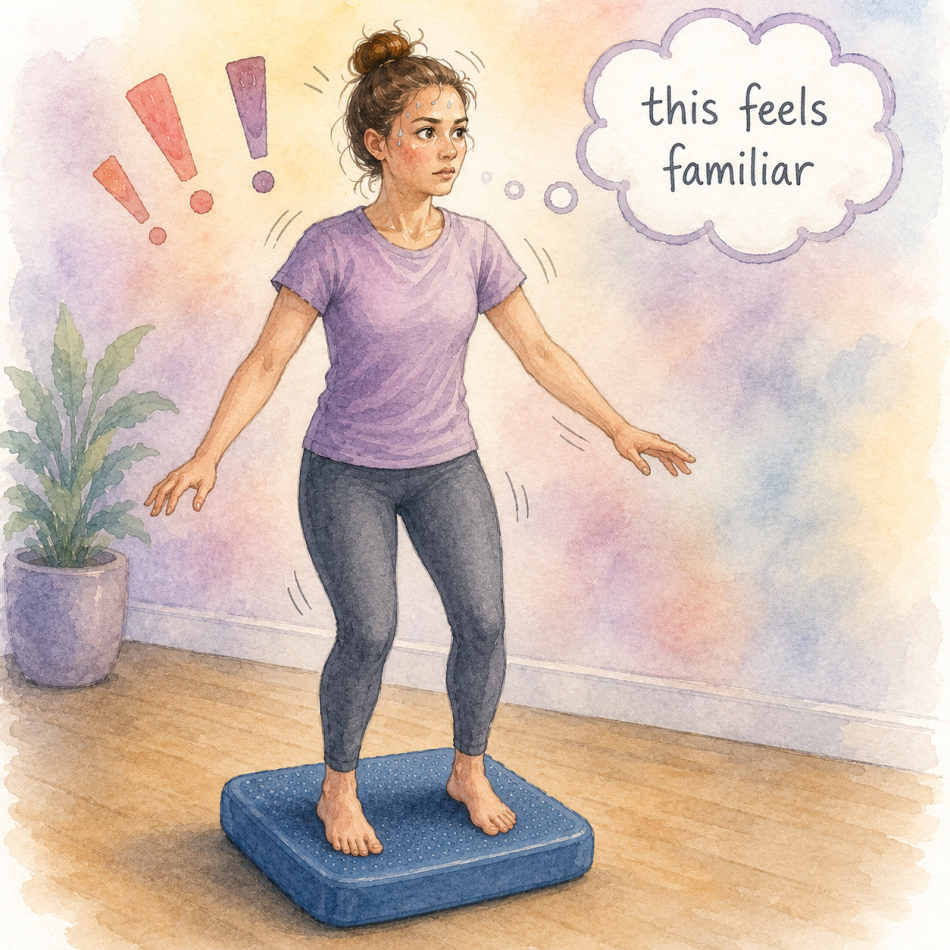
In one session, my physical therapist positioned me on a balance cushion, adjusted my posture, and asked me to close my eyes.
Twenty seconds later, I found myself unexpectedly emotional- not because I uncovered a memory. Not because anything dramatic happened. Rather, I recognized a familiar state.
It felt like hypervigilance.
As I stood there trying to maintain balance without relying on my usual compensations, I felt a subtle readiness—a scanning, a waiting, a sense that I needed to stay alert to what might happen next.
The feeling was instantly familiar.
I had felt it navigating the world these past few years with chronic vertigo. Heck, just walking from the car to a storefront was like being on a carnival ride. I had also felt it during years of caregiving. And if I am honest, I have felt versions of it for much of my life.
I stepped off the cushion, sat down and cried big tears. I was in an abreactive state. I was grateful for the release.
Somatic Work Doesn’t Always Look Like Somatic Work
When people hear the phrase somatic bodywork, they often think of yoga, massage, breathwork, or body-centered psychotherapy.
Yet some of the most profound somatic experiences of my life have occurred in unexpected places: during a Feldenkrais lesson following an injury, in the office of a gentle chiropractor, and most recently, in a physical therapy session.
Somatic work is not defined by the technique being used. It is defined by what happens when the body is invited into a new experience. Sometimes the body responds with relief. Sometimes with emotion. Sometimes with insight. Sometimes with all three.
The body has its own way of revealing patterns we may not have fully noticed before.
Adaptation Is Not Identity
What struck me most about this experience was not the diagnosis itself. It was the realization that many of the ways we move through life begin as adaptations.
We adapt to illness. to caregiving, to uncertainty, to loss
We adapt to environments that require us to remain alert.
Over time, these adaptations can become so familiar that we mistake them for who we are.
“I’ve always been anxious.”
“I’ve always been the responsible one.”
“I’ve always been independent.”
Perhaps. But what feels normal is not always natural. Sometimes it is simply familiar.
The Promise of Neuroplasticity
The good news is that the nervous system remains remarkably adaptable. The same brain that learns compensations can learn new possibilities.
This is the foundation of neuroplasticity. Through repeated experiences, the nervous system reorganizes itself. New pathways develop. Old patterns loosen. What once felt automatic can gradually become optional. And as these new pathways develop, a dysregulated nervous system often begins to settle. Yet I have come to appreciate that regulation is not always as simple as “calm your vagus nerve.”
In my case, a weakened vestibular system has been sending confusing signals to the brain for years. It is difficult for the nervous system to fully relax when the body is continually working to maintain its sense of balance and orientation. The vagal system can support regulation, but it is challenging to feel safe when the internal experience is one of instability.
I think of it this way: it is hard to calm down on a rocking boat. The nervous system settles more easily when it can find the horizon. Vestibular rehabilitation is helping my brain do exactly that—finding its horizon again.
Another Way of Standing in the World
Many people experience unexpected emotions during physical rehabilitation. Some cry. Some feel fear. Some feel frustration. Yet they don’t necessarily connect those experiences to a larger story, and their body still improves.
The body does not require insight in order to heal. And yet, for those willing to pay attention, insight sometimes arrives alongside the healing process. The insight for me was not that hypervigilance is bad. In many seasons of life, it served an important purpose. It helped me navigate challenge, responsibility, uncertainty, and change.
The question is not whether an adaptation once served us. The question is whether it is still needed.
Healing is not only about reducing symptoms. It is also about becoming aware of the patterns we have built around those symptoms and gently exploring whether another way of standing in the world is possible.
Sometimes that exploration begins in a therapy office. Sometimes it begins with a diagnosis.
And sometimes it begins with twenty seconds on a balance cushion.
Support My Writing
I write because I have things I want to explore, question, and share, and much of that writing lives here freely. If my work has resonated with you or given you something to think about, your support helps me keep doing it.