
 Have you ever tossed a coin into a fountain and made a wish? Or flipped a coin when you couldn’t make up your mind about something? Perhaps you’ve opened a Bible or another sacred text to a random page, hoping to find a message that speaks to something happening in your life. Maybe you’ve pulled an oracle card, carried a special stone in your pocket, or noticed a particular animal appearing at just the right moment.
These are familiar experiences, and while not all are technically forms of divination, they share something in common: the human inclination to seek meaning, guidance, and perhaps a little reassurance from something beyond our ordinary ways of thinking.
The word divination often conjures images of fortune tellers, crystal balls, and predictions about the future. For some, it evokes curiosity and wonder. For others, it raises religious concerns or skepticism. Yet divination has a much broader history and purpose than predicting who we will marry, whether we’ll win the lottery, or what fate has in store for us.
I am much more interested in divination as a way of exploring what we may already know, but have not yet brought into conscious awareness.
Beyond Fortune-Telling
Merriam-Webster offers two definitions of divination. The first describes the practice of foretelling future events or discovering hidden knowledge through omens or supernatural means. The second is considerably simpler: unusual insight; intuitive perception.
It is this second definition that resonates with my approach to psychospiritual practice.
Rather than looking to a divination tool to tell us what will happen, we might use it to explore what is happening within us. An oracle card, an essential oil, a crystal, or even the image that appears in the coffee grounds at the bottom of a cup can become an invitation to pause, reflect, and notice something that might otherwise remain outside our awareness.
Consider the simple act of flipping a coin to make a decision. We assign heads to one choice and tails to another, toss the coin, and wait for the result. But sometimes the most revealing moment comes after the coin lands. We notice that we’re disappointed with the outcome, or perhaps unexpectedly relieved. The coin hasn’t necessarily told us what to do, but our reaction may have revealed something about what we wanted all along.
The same principle can apply to other forms of divination. The object or image becomes a catalyst for reflection, and the meaning emerges through our relationship with it.
Divination and Psychological Assessment
One of the more intriguing comparisons I’ve encountered comes from psychologist Paul Larson, who explored parallels between divination and psychological assessment in a 2019 article published in The Humanistic Psychologist.
Larson describes divination as a psychospiritual technique that may facilitate personal growth through gnosis, a form of knowing associated with direct insight or experiential understanding. He observes that both psychological assessment and divination involve interpreting signs and communicating meaning within the context of another person’s experience.
Of course, this doesn’t mean that pulling an oracle card is equivalent to administering a standardized psychological assessment. Psychological instruments have particular purposes, procedures, and standards for validity and reliability. Divination tools do not necessarily operate within those same parameters.
However, there are interesting parallels when we consider projective approaches to psychological exploration.
Think about the familiar Rorschach inkblot test. A person is presented with an ambiguous image and asked what they see. The image itself does not contain a prescribed narrative, yet the viewer responds by drawing upon perception, memory, associations, and personal experience. In formal assessment, those responses are interpreted through established procedures. Outside that context, ambiguous images can also serve as prompts for personal reflection.
Something similar may happen when we select an oracle card.
One person may notice a doorway in the background of an image and associate it with a new beginning. Another may focus on the dark clouds overhead and recall a difficult period in life. Someone else may be drawn to a small bird perched on a branch, remembering a loved one who has died.
The card hasn’t changed, but the experience of encountering it is deeply personal.
And that is where the process becomes interesting. Rather than assuming that an image carries one universal message, we can explore what the image evokes in the person who encounters it.
Jung, Symbols, and the Unconscious
Carl Jung believed that the unconscious communicates through symbols and images, and that engaging with this symbolic material can deepen our understanding of ourselves. Dreams, myths, archetypes, active imagination, and creative expression all offer opportunities to explore aspects of the psyche that may not be readily accessible through ordinary conscious thought.
Within Jungian psychology, the process of individuation involves becoming increasingly aware of the different dimensions of ourselves, including those we have overlooked, rejected, or not yet fully developed.
Symbols can play an important role in that process because they invite us into a relationship with something that cannot always be explained through literal language.
A snake, for example, might evoke fear for one person and transformation for another. Water may symbolize cleansing, birth, danger, spirituality, or a childhood memory of swimming in the ocean. The meaning is not necessarily found in a dictionary of symbols but in the relationship between the symbol and the person encountering it.
This is one reason I find oracle cards, essential oils, and crystals so interesting as tools for psychospiritual exploration. In my Essential Soul Care® work, these objects may be approached as divination tools, but they can also serve as projective, sensory, and somatic invitations to explore unconscious motivations, memories, emotions, and embodied experiences.
An essential oil might evoke a forgotten memory or an unexpected emotional response. A crystal may become a tactile point of focus during contemplation. An oracle card may present an image that seems to speak directly to a situation we have been struggling to understand.
None of these experiences requires us to assign supernatural powers to the object itself. Nor must we dismiss the spiritual significance that someone may find in the encounter.
Is It Psyche, Intuition, or Spirit?
This is where the conversation becomes especially interesting to me.
When an image, aroma, or seemingly chance encounter brings forward an unexpected insight, how do we understand what has happened? Was it psychological projection, unconscious pattern recognition, intuition, synchronicity, or something we might call spiritual guidance?
Perhaps it depends upon the worldview of the person having the experience. A psychologist may understand the encounter through the lens of unconscious associations, while someone grounded in a spiritual tradition may experience the same moment as guidance from God, Source, the Universe, or Spirit.
I don’t believe we always have to choose one explanation at the expense of another.
There is room for psychological understanding and spiritual meaning to coexist, provided we remain thoughtful about the interpretations we make and the authority we give them. An experience can be personally meaningful without becoming an unquestionable truth, and an intuitive impression can be explored without assuming that it predicts an inevitable outcome.
This distinction is especially important when working with divination tools. There is a difference between using an oracle card to explore one’s feelings about a relationship and declaring that the card has revealed another person’s intentions. There is a difference between noticing a meaningful coincidence and assuming that every coincidence carries a directive from the Universe.
For me, divination is most useful when it expands awareness rather than replaces discernment. It can invite curiosity, deepen reflection, and offer another way of approaching questions that resist easy answers. It should not require us to surrender our judgment or hand over responsibility for our choices.
And sometimes, the most meaningful insight isn’t particularly mysterious at all. It may simply be the recognition of something we’ve known for a long time but haven’t quite been ready to acknowledge.
Making the Unseen Visible
Throughout human history, people have looked to nature, dreams, sacred texts, symbols, and ritual objects for guidance. Whether we understand these practices as spiritual communication, psychological exploration, or some combination of the two, they reflect an enduring desire to find meaning in our experiences.
Perhaps that is part of what makes divination so compelling. It creates an intentional moment in which we interrupt our usual patterns of thinking and become receptive to another perspective.
We don’t necessarily need to believe that the cards know our future, that a crystal contains the answer to our dilemma, or that the Universe has arranged every detail of our day to deliver a message. We can simply remain open to what emerges when we engage with an object, image, or experience in a contemplative way.
And for those who do understand such encounters as expressions of Spirit, the experience may carry an additional layer of sacred meaning.
Either way, the invitation is not to abandon critical thinking but to make room for imagination, intuition, and the symbolic language of the unconscious.
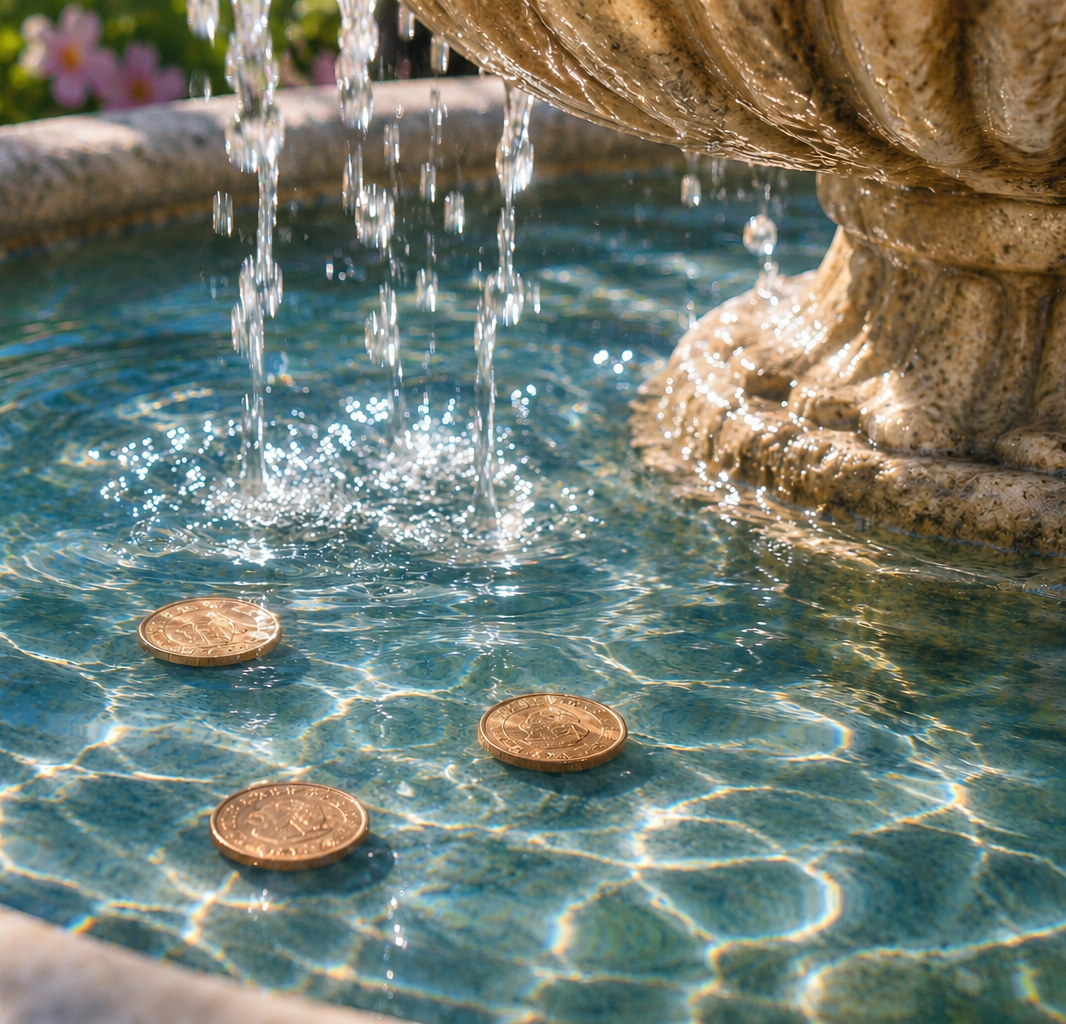
Which brings me back to those three coins in the fountain.
When we toss a coin into the water and make a wish, we may be participating in a charming tradition, expressing hope, or engaging in a small ritual of intention. The fountain doesn’t have to grant the wish for the moment to matter.
Perhaps the more interesting question is what the wish reveals about us.
What are we longing for? What are we hoping will change? And what might that small, ordinary gesture tell us about the life we are trying to create?
Sometimes making the unseen visible begins with something as simple as a coin, a wish, and a moment of reflection.
Soul Note • Journal Prompt
Choose an object, image, oracle card, aroma, or natural element that catches your attention today. Before looking up what anyone else says it means, spend a few moments with it.
What do you notice? What does it evoke? And what might become visible if you allow your own associations to speak first?
References and Further Reading
Jung, C. G. (1964). Man and his symbols. Dell.
Larson, P. (2019). Psychological assessment and divination: Some parallels of process. The Humanistic Psychologist, 47(1), 76–91. https://doi.org/10.1037/hum0000109
Olbert, C. M. (2018). Divination practices: An empirical psychological investigation [Doctoral dissertation, Fordham University].
PositivePsychology.com. Jungian psychology: Theory and key concepts. https://positivepsychology.com/jungian-psychology/
Support My Writing
I write because I have things I want to explore, question, and share, and much of that writing lives here freely. If my work has resonated with you or given you something to think about, your support helps me keep doing it.