
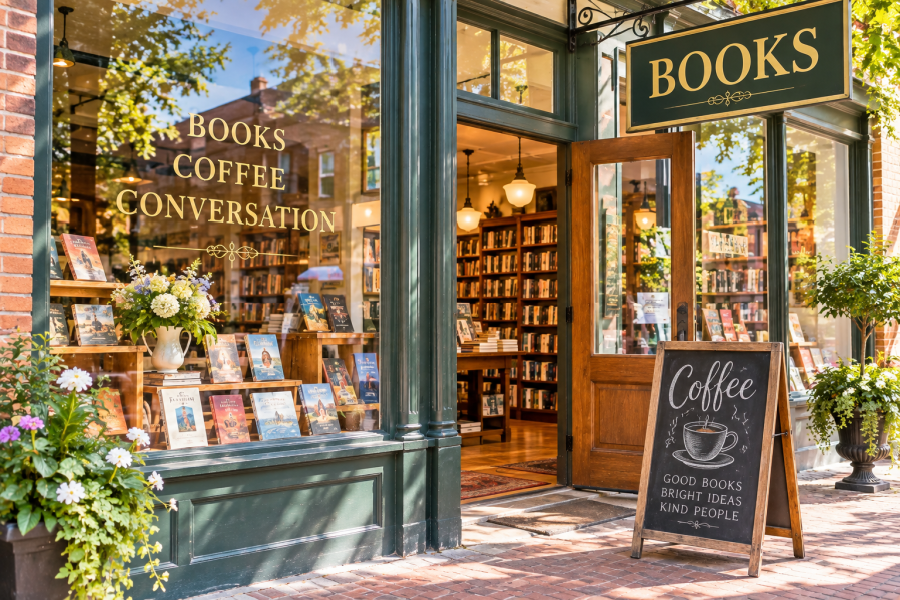
 It started with a passing news headline about Starbucks closing retail locations. I’m not sure why that trivial item caught my eye, except that it nudged open an old door to a time before there was coffee shop on every corner. I suddenly found myself trying to remember the name of a specific coffee shop in Atlanta where I spent hours buried in books during my late twenties when I was finishing my undergraduate degree at Georgia State. I could picture the staircase. I remembered the bookstore wrapped around it. I could see the tables where I spread out my notes, but for as many hours as I logged there, I couldn’t remember the name. So I googled it.
Cup & Chaucer inside Oxford Books.
The instant the names appeared, memories from the ten years I lived in Atlanta came rushing back. The original Flying Biscuit, back when it felt less like a breakfast spot and more like a neighborhood gathering place. Chapter 11 Books on West Paces Ferry, where I worked, and the deli next door that sustained me on matzo ball soup. Bartending shifts in Decatur, breakfast at the Majestic Diner and taking MARTA to Georgia State University, where I was an older student navigating an urban campus, determined to finish my degree by thirty.
Memory, once revealed, is not often a sensible timeline. One memory cascaded into another until the timeline brought me back to Clifton Presbyterian Church. Somewhere in the conversation and articles from that time period, a word came up that I had never once used to describe myself back then: counterculture.
The Atlanta I Was Living In
I landed at Clifton in the fall of 1991 looking for a required undergraduate practicum in human services. The congregation was tiny, and every evening it turned its sanctuary into a homeless shelter for men. My practicum ended, but I didn’t leave. Over the next five years, that community reshaped me. I worked at Clifton and I worshipped at Clifton. I eventually stepped away from the Greek Orthodox church of my upbringing, became an ordained Presbyterian elder, and found myself inside a More Light congregation that was deliberately and vocally affirming gay and lesbian people at a time when the broader culture and the wider church often wasn’t.
I marched with our church banner in the Atlanta Gay Pride Parade. At the same time, I was a bisexual woman who was not publicly out. I was entering the mental health profession, and back then, well, you just didn’t go there. It was a southern city, not necessarily a cosmopolitan one. But there I was, marching openly for inclusion while keeping part of myself private. Oddly enough, I don’t remember experiencing that as a contradiction. It was simply the world I was navigating at the time.
Corporate Atlanta tried to give the city a shiny new coat prior to the 1996 Olympics. That really meant keeping the homeless population out of site. And that meant my job was about finding more ways for hospitality to be extended to our homeless guests for several weeks. Turning Atlanta into a world-class “Olympic City,” meant homeless people became the primary target of displacement and arrests causing advocates like myself to shout even louder.
We have much more intentional language now for diversity, equity, inclusion, belonging and systemic trauma. Those weren’t terms I remember circulating through my daily life in the early 1990s. The questions we asked though, did reflect the same intention. Who gets welcomed? Who gets housed and fed? Who gets treated as part of the community?
Before long, those questions moved right into my personal life. In 1994, my then-husband and I welcomed a young man with significant disabilities into our home. He had spent nearly his entire life within the walls of an institution. Deinstitutionalization wasn’t policy or critique for us. It was a person sitting across the kitchen table, sharing supper.
Two years later, I wrote an article for Open Hands titled “Valuing Differences: A Process of Experience.” When I pulled out that old journal again, I had to laugh. The issue was subtitled, Weaving Community from Diversity. Apparently, we had some of the language after all.
Becoming a Counselor
All the while, I was wrestling with my own vocation, considering which graduate program to apply for. After graduating from Georgia State, I considered pastoral counseling at Columbia Theological Seminary, but institutional religion had already begun to feel too narrow for where I was spiritually. I also looked longingly at Pacifica Graduate Institute in California. I was drawn to Jung, depth psychology, psyche and soul, but Pacifica was expensive and my reality was rooted in the South, where I worked with people who were often disenfranchised. So I did the practical thing. I took a scholarship to the University of Georgia and trained in rehabilitation counseling.
Uber practical.
More than thirty years later, I finally made my way back to Pacifica for postgraduate study. Apparently, the practical counselor and the woman drawn to psyche and soul were both going to get their turn. No mistake that I am often referred to now as “the practical pixie.”
Looking Back Without Looking Backward
These days, I spend much of my time teaching and mentoring therapists, coaches and healers, many of whom are younger than I am. Sometimes there is an assumption that older generations need to be brought up to speed on what it means to be inclusive. And to be fair, language evolves, blind spots get illuminated, and I have had plenty to learn and unlearn along the way. But that unexpected detour through my memories reminded me that much of what shaped my ethics wasn’t something I learned in a classroom.
I learned about homelessness from men who rolled up their sleeping mats on Sunday mornings so the sanctuary could become a church again. I learned about institutionalization by sharing my home with someone who had spent most of his life in one. I learned about inclusion while marching behind a church banner in a Pride parade, and something about the complexity of identity while keeping part of my own private. Somewhere along the way, I also learned that my own spirituality was growing beyond the walls of religion.
I wasn’t collecting credentials in inclusion. I was a thirty-something woman in a changing city, drinking coffee upstairs at Cup & Chaucer, balancing work and tuition, and trying to align my life with what felt humane.
Many of those physical places are gone. Oxford Books closed long ago. Atlanta has reinvented itself several times over since then. We don’t lose the places that shape us. Sometimes all it takes is a passing news story to bring one of them back. I started out looking for the forgotten name of a coffee shop. What I ended up finding was the younger version of myself who spent her days there.
She was messy, pragmatic, quiet about her own secrets, and braver than she knew.
I rather like her.
Support My Writing
I write because I have things I want to explore, question, and share, and much of that writing lives here freely. If my work has resonated with you or given you something to think about, your support helps me keep doing it.