

 When Connection Becomes a Search for the Self

There are encounters in life that seem to reach beyond ordinary attraction. We meet someone and experience an inexplicable familiarity, an emotional intensity, or a sense that something within us has been awakened. Perhaps the connection feels spiritual, even destined. We may call this person a soulmate or twin flame. Or, depending on whom we ask, someone may suggest we’re experiencing limerence.
Lately, I’ve noticed these terms appearing in similar conversations, sometimes almost interchangeably. There are even online communities where people refer to their limerent object (LO) much as others refer to their twin flame (TF). But are we talking about the same experience?
I don’t think so. Although there may be overlapping experiences, the psychological and spiritual frameworks are quite different. And from a depth psychology perspective, the distinction raises an interesting question: Does the encounter keep us searching for another person, or does it ultimately lead us toward discovering ourselves?
Understanding Limerence
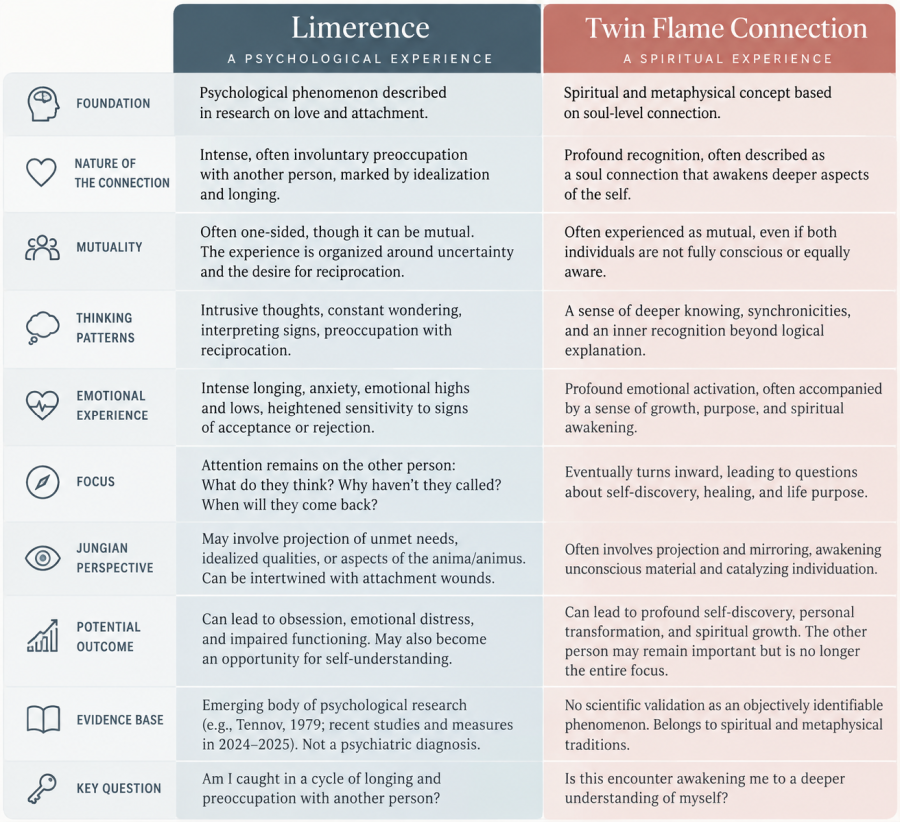
Psychologist Dorothy Tennov introduced the term limerence in her 1979 book, Love and Limerence: The Experience of Being in Love. She described an intense, often involuntary preoccupation with another person, accompanied by intrusive thoughts, emotional dependency, and a powerful longing for reciprocation.
Limerence frequently develops when affection is uncertain or unrequited, although mutual limerence is possible. The person experiencing limerence may spend considerable time interpreting conversations, searching for hidden meanings, imagining future encounters, or wondering whether the other person shares their feelings.
What did that text mean? Why haven’t they called? Are they thinking about me? When will they come back?
The beloved becomes the organizing center of the experience.
Limerence is not itself a psychiatric diagnosis, nor does experiencing it automatically indicate psychological pathology. However, research has explored its associations with obsessive thinking, attachment insecurity, emotional distress, and impaired functioning. In some circumstances, limerence may become intertwined with existing psychological vulnerabilities.
A growing body of research is examining these experiences, including a 2024 scoping review of limerence, fixation, and rumination, and the development of a limerence questionnaire published in 2025.
What concerns me is the tendency to romanticize limerence as evidence of an extraordinary connection. When obsessive longing is interpreted as proof that two people are destined to be together, the psychological experience may become more difficult to recognize for what it is.
The Spiritual Language of Twin Flames
Twin flames belong to a different framework altogether. The concept is spiritual and metaphysical rather than clinical, generally describing two people who experience a profound connection that seems to transcend conventional relationships.
Within twin-flame spirituality, the encounter is often understood as mutual recognition at a soul level. The connection may involve synchronicities, intense emotional responses, mirroring, and an awakening of previously unconscious aspects of the self.
Some believe twin flames share an energetic or spiritual bond that exists regardless of physical proximity or whether the relationship becomes romantic. One person may be more consciously aware of the spiritual dimensions of the encounter than the other.
Of course, we cannot know another person’s inner experience simply because we feel an extraordinary connection. Mutuality cannot be established through intuition alone, and spiritual beliefs should never become justification for ignoring someone’s boundaries.
Unlike limerence, which has an emerging body of psychological research, twin flames have not been scientifically established as an objectively identifiable phenomenon. Yet the absence of scientific validation does not prevent us from exploring the meaning people attribute to these encounters.
This is where Jungian psychology offers an intriguing perspective.
When the Other Person Becomes a Mirror
Carl Jung understood that our encounters with others can activate unconscious material, particularly through projection.
We may recognize qualities in another person that we have not yet acknowledged within ourselves. These might include creativity, courage, sensuality, vulnerability, spiritual longing, or aspects of our shadow that have remained outside conscious awareness.
The encounter may feel strangely familiar because something within our own psyche is being reflected back to us.
Jung’s understanding of projection does not necessarily diminish the significance of the relationship. Rather, it invites us to examine what the other person represents within our inner world.
Someone may awaken an aspect of ourselves that has been dormant for decades. We may suddenly question our marriage, career, identity, spirituality, sexuality, or the life we have carefully constructed.
The encounter becomes a catalyst.
In Jungian terms, this may contribute to individuation, the lifelong process of becoming more conscious of who we are, integrating previously unconscious aspects of ourselves, and moving toward greater psychological wholeness.
But there is an important distinction between recognizing ourselves through another person and believing that we cannot become whole without them.
Obsession or Discovery?
This is where I find the comparison between limerence and twin-flame experiences most interesting.
Limerence can become a search for the other. A spiritually transformative encounter can become a search for the Self.
In limerence, attention may remain fixed on obtaining affection, confirmation, or reciprocation. The emotional world becomes organized around the other person’s availability, actions, and responses.
A transformative encounter, on the other hand, may begin with equally intense feelings but eventually direct our attention inward.
Instead of asking whether the other person will return, we begin asking why the encounter affected us so profoundly. What did this person awaken? What aspects of ourselves have we neglected? What changes are we being invited to make?
The other person may remain important, but they cease to be the entire point of the story.
Interestingly, these experiences are not necessarily mutually exclusive. Someone experiencing limerence may begin exploring their attachment patterns, projections, and unmet emotional needs. Through that process, an initially obsessive experience may become an opportunity for psychological growth.
Likewise, someone who identifies an encounter as a twin-flame connection may become so preoccupied with reunion, separation, or the familiar runner-chaser narrative that the spiritual interpretation reinforces obsessive attachment rather than self-discovery.
The label alone tells us very little about the direction of the experience.
When the Connection Changes Us
I don’t believe every meaningful spiritual encounter must culminate in a romantic relationship. Some connections may be brief. Others may remain friendships, unfold across considerable distance, or never develop beyond a handful of conversations.
Yet their influence may continue long after the encounter itself.
From a psychospiritual perspective, we can honor the mystery of such experiences without insisting upon a particular explanation. We can remain curious about synchronicity, intuition, and spiritual recognition while also attending to projection, attachment, and the realities of human relationships.
Perhaps the most meaningful question isn’t whether someone is our twin flame or our limerent object.
Perhaps it is whether the encounter has expanded our capacity to know ourselves, live authentically, and relate to others with greater consciousness.
After all, an extraordinary connection need not result in two people being together to become part of their individual journeys.
The spiritual significance of an encounter may have less to do with whether two people are destined to be together and more to do with what becomes possible within each person because they met.
Soul Note: A Writing Reflection
Think of someone whose presence profoundly affected your life, whether romantically, spiritually, or simply through an unexpected encounter.
What did this person awaken within you? Did the experience draw you further into longing for the other person, or did it eventually reveal something about yourself that you had not previously recognized?
Consider what remains meaningful about the encounter, even apart from the relationship itself.
References
Bradbury, P., Short, E., & Bleakley, P. (2025). Limerence, hidden obsession, fixation, and rumination: A scoping review of human behaviour. Journal of Police and Criminal Psychology, 40, 417–426. https://doi.org/10.1007/s11896-024-09674-x
Jung, C. G. (1959). Aion: Researches into the phenomenology of the self (R. F. C. Hull, Trans.; Vol. 9, Part 2). Princeton University Press.
Marshall, L., Waldeck, D., Pancani, L., Churchill, S., & Tyndall, I. (2025). Development and validation of the Limerence Questionnaire (LQ-11). Psychological Reports. https://doi.org/10.1177/00332941251394980
Tennov, D. (1979). Love and limerence: The experience of being in love. Stein and Day.