

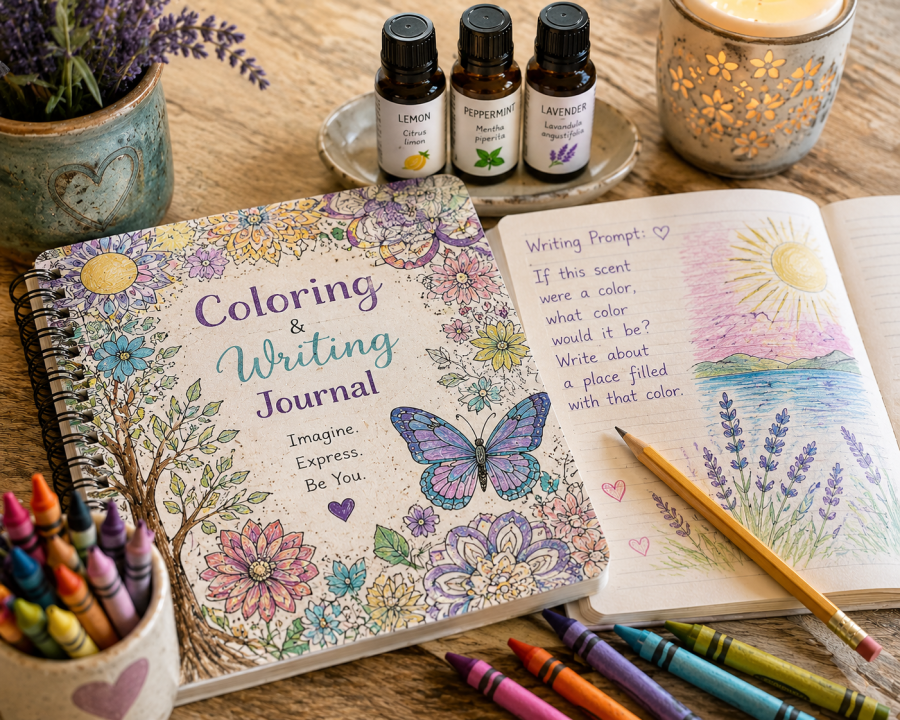
 Recently, a few therapists have asked me if I would share some of the essential oils and writing prompts I use in my work. Most speak about working with adults but a few therapists who work with children and adolescents have also asked, seeking creative ways to support the young people in their practice.
I should say first that I do not specialize in working with children or adolescents. My work with contemplative and therapeutic writing has primarily been with adults and professionals. But the questions stayed with me.
What might happen if we introduced a scent simply as a creative invitation?
Not as treatment. Not as a prescription. Not lavender for anxiety or peppermint for focus. Simply as another way of noticing, imagining, and finding words.
Scent → Imagination → Symbol → Writing
That is where I would begin.
The Nose Knows More Than We Think
Our sense of smell has an intimate relationship with memory and emotion. Sometimes a scent is pleasant. Sometimes it is unpleasant. Sometimes it seems strangely familiar even when we cannot quite place why.
Those of us who work therapeutically know that this deserves some respect.
I often speak of aroma as a portal. A scent can open an interior door before the thinking mind has decided whether it wants to enter. This is one reason I would be cautious about deliberately asking a young person, What memory does this smell bring up? or What does this remind you of from your childhood?
That door may open wider than expected.
Instead, I would keep the invitation creative, symbolic, and spacious.
If this scent were a color, what color would it be?
If it had a personality, what would it be like?
If this scent were the beginning of a story, what happens next?
We are not demanding disclosure. We are inviting imagination.
A Simple Way to Introduce Scent
For this kind of writing experience, I would not apply an essential oil to a young person’s skin. I am also not suggesting diffusing an oil throughout the therapy room.
The encounter with the aroma can be brief and intentional.
With appropriate consent and attention to individual sensitivities and essential oil safety, the therapist can retain control of the bottle, holding it initially around chest level and slowly bringing it closer until the young person notices the aroma. There is no need for deep, dramatic inhalation. We are simply noticing.
Then comes the writing prompt.
Smell. Notice. Imagine. Write.
The young person can write a sentence, a paragraph, a poem, a list, or an entire story. Younger children might prefer to draw first and add words later. The goal is not polished writing.
The goal is expression.
Three Aromas, Three Creative Invitations
If I were choosing three familiar essential oils for brief olfactory exploration with older children and adolescents, I might begin with lemon, peppermint, and lavender.
Lemon: Brightness and Possibility
Lemon has a bright, lively aromatic presence. Rather than telling a young person how lemon is supposed to make them feel, I would invite curiosity.
What feels sunny?
What feels awake?
What feels new?
Perhaps lemon becomes yellow. Perhaps it becomes a summer afternoon. Perhaps it becomes a character who talks too much and wears mismatched socks.
The young person’s imagination gets the final word.
Peppermint: Movement and Imagination
Peppermint has a sharp and immediately noticeable aromatic quality. For older children and adolescents, brief and supervised olfactory exploration may offer an interesting starting place for writing.
What feels quick?
What feels surprising?
What has energy?
Peppermint might become an icy mountain, a superhero, a snowstorm, or a person who enters a room and changes everything.
Again, we do not assign meaning.
We notice what emerges.
Lavender: Quiet and Inner Space
Lavender is frequently associated with calm and relaxation, but even here I would resist telling the young person what they are expected to experience.
What feels soft?
What feels spacious?
What feels dreamy?
For one person, lavender may become a quiet room. For another, a purple dragon. Someone else may simply write, I don’t like this smell.
That, too, is information. And perhaps the beginning of something creative.
Ten Gentle Writing Prompts to Try
The prompts I would choose are intentionally general. They invite projection and imagination without deliberately pulling for autobiographical or traumatic material.
- If this scent were a color, what color would it be? Write about a place filled with that color.
- If this scent had a personality, what would it be like?
- Imagine this scent is the beginning of a story. What happens next?
- If this scent could speak, what would it say today?
- What kind of weather belongs with this scent? Describe the day.
- Create a character who would choose this scent as their superpower. What can they do?
- If this scent were a room, what would be inside it?
- Give this scent a new name. Why did you choose it?
- Imagine putting this scent in a tiny bottle to take on an adventure. Where would you go?
- Finish this sentence: When I noticed this scent, I imagined…
These are not assessment questions. I would be cautious about interpreting a young person’s response or turning every purple dragon into a clinical metaphor.
Sometimes a purple dragon is simply a very good story.
And sometimes a symbol carries something more.
The art of therapeutic work is knowing how to remain curious without rushing in to explain.
Let the Scent Be a Creative Companion
I am interested in what happens when we give people more than one way to know and express what is stirring within them.
Writing offers one path. Aroma offers another. Imagination creates a bridge between the two.
For young people who tire of being asked How do you feel? or Do you want to talk about it?, perhaps there is value in occasionally offering a different invitation:
What does this scent make you want to write?
Then we become quiet enough to see where their imagination takes them.
Aromatherapy Safety Guidelines from NAHA
Support My Writing
I write because I have things I want to explore, question, and share, and much of that writing lives here freely. If my work has resonated with you or given you something to think about, your support helps me keep doing it.

Interested in learning more? Take this Free course!