
 I’ve been working with oracle cards for years, both personally and through the development of the Essential Soul Care Oracle Deck. What continues to interest me isn’t simply the message printed on a card, but what happens when someone encounters an image and begins to make meaning from it. Sometimes a symbol captures our attention. Other times, an image evokes a memory, an emotion, or an association that seems to have little to do with the card itself. Yet these responses may offer a glimpse into something we haven’t fully recognized or articulated.
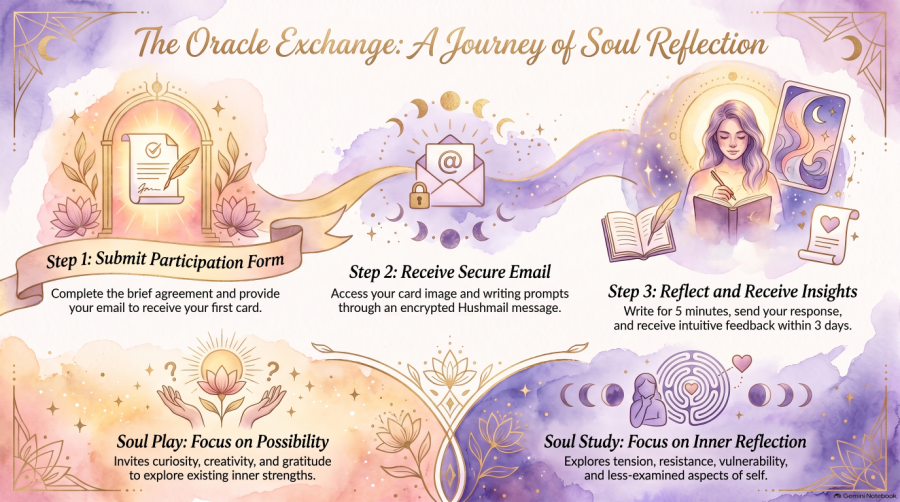
This curiosity led me to develop The Oracle Exchange, a reflective writing and intuitive reading experience that combines oracle imagery, contemplative writing, and intuitive dialogue. While the experience is relatively simple, the ideas informing it draw from depth psychology, particularly Carl Jung’s exploration of the unconscious, symbolic imagery, and active imagination.
The Symbolic Language of the Unconscious
Jung recognized that the unconscious communicates through images, symbols, dreams, fantasies, and associations that may not immediately make sense to the conscious mind. He distinguished between signs, which point toward something already known, and symbols, which suggest meanings that cannot yet be fully explained or understood.
This distinction is particularly relevant to oracle imagery. A symbol isn’t necessarily something to decode according to a predetermined interpretation. While traditional meanings provide a useful framework, the personal associations an image evokes may be equally significant.
Consider an image of a doorway. One person may associate it with opportunity, while another remembers a childhood home. Someone else may experience apprehension without understanding why. The image remains the same, but the psychological experience differs.
These associations invite curiosity about the relationship between conscious awareness and unconscious material. The image provides a starting point, while the individual’s response contributes to the meaning that develops around it.
Active Imagination, Embodiment, and Writing
Jung developed active imagination as a method of consciously engaging with material arising from the unconscious. Rather than simply observing or interpreting an image, the individual enters into a relationship with it, allowing the experience to unfold through imagination, dialogue, writing, or artistic expression.
The Oracle Exchange isn’t intended to replicate Jung’s formal method, but it draws upon a related principle: engaging with symbolic material can encourage dialogue between conscious awareness and aspects of experience that haven’t yet found expression.
My interest also extends to embodied active imagination, where attention includes the body’s participation in the experience. An image might evoke warmth, a tightening in the stomach, a change in breathing, or an unexpected sense of ease. These sensations don’t necessarily carry a specific psychological meaning, but they may offer another avenue for reflection.
Contemplative writing introduces an additional dimension. Unlike writing intended to communicate a finished idea, it allows us to discover what we think and feel through the act of writing itself. An unexpected word appears, a memory surfaces, or we recognize a contradiction between what we believe and what we’ve just written.
By allowing a few minutes of writing without immediately editing or evaluating our responses, we create space for associations that might otherwise be overlooked. This doesn’t mean spontaneous writing reveals some infallible unconscious truth. It simply provides material for curiosity and exploration.
Shadow, Projection, and Inner Knowing
Jung’s concept of the shadow adds another layer to this work. The shadow encompasses aspects of ourselves that remain outside conscious identification, often because they conflict with our self-image or internalized expectations.
Although shadow work is frequently associated with difficult emotions or undesirable traits, qualities such as creativity, assertiveness, vulnerability, and joy may also become disowned.
Symbolic imagery can provide an indirect way of approaching these aspects of experience. We may feel drawn to a quality represented in an image while struggling to recognize it in ourselves. Conversely, a strong negative response might invite us to consider what the image represents within our personal history.
Projection is relevant here as well. We inevitably bring our experiences and assumptions to the images we encounter. Rather than treating this as something to eliminate, we can recognize it as part of the meaning-making process.
Not every response reveals shadow material, of course. Sometimes we simply dislike an image. But when a reaction seems particularly charged or unexpected, it may be worth exploring.
Reflective Rather Than Predictive
Oracle cards have a longstanding association with divination, and many people approach readings hoping for insight into future events or decisions. My approach, however, is primarily reflective.
I’m interested in how an oracle reading can help someone explore their present experience, recognize patterns, consider possibilities, and deepen their relationship with intuition.
This also changes the relationship between reader and participant. Rather than positioning the reader as the sole interpreter of meaning, the process becomes collaborative. The participant’s experience is central, while the reader contributes additional perspectives, symbolic associations, and intuitive observations.
I see this as an empowering approach to intuitive work. It respects the individual’s capacity for discernment while recognizing that another person’s perspective may illuminate something previously overlooked.
The Oracle Exchange
The Essential Soul Care framework provides the foundation for this experience through seven interconnected elements: Transcendence, Intuition, Mindset, Community, Nourishment, Creativity, and Sanctuary.
The participant begins by choosing an element that resonates with them. I select a card from the Essential Soul Care Oracle Deck and provide its image along with a brief contemplative writing invitation. Before receiving my interpretation, the participant spends approximately five minutes responding to the card and returns their writing to me.
This sequence is intentional. Encountering the image before receiving its established meaning allows personal associations to emerge without first being shaped by someone else’s interpretation.
I then consider the participant’s response alongside the card’s original oracle message, the meaning of their chosen Essential Soul Care element, and my own intuitive observations. My written reply brings these perspectives together and offers possibilities for further exploration.
The exchange can end there, or the participant may choose to continue through a clarification or another card.
What appeals to me about this format is its simplicity. It creates a small, intentional space where imagery, writing, intuition, and reflection come together without requiring a lengthy session or elaborate process.
Throughout my professional and spiritual work, I’ve been drawn to approaches that honor the complexity of human experience without assuming everything must be explained or resolved. Sometimes reflection leads to a significant realization. Sometimes it raises another question. And sometimes the value is simply taking a few minutes to attend to something we might otherwise have overlooked.
I don’t regard oracle cards as possessing all the answers, nor do I believe an intuitive reader should claim exclusive access to someone else’s inner world. I do believe that images can stimulate imagination, writing can reveal unexpected associations, and thoughtful dialogue can expand our understanding of what emerges.
The Oracle Exchange is an invitation to participate in that conversation.
Explore The Oracle Exchange HERE.